
Advertisement feature — this page is published by Scentech.
How to use an essential oil diffuser: drops, water, timing and cleaning
Most essential oil diffusers arrive with a leaflet the size of a bus ticket, printed in six languages, and the useful sentences are spread across three of them. This page collects the things people actually look up afterwards: how much water, how many drops, how long to leave it on, what to do when the room stops smelling of anything, and the ten minutes of cleaning that decide whether the machine lasts a year or five. Every figure here is one a maker or a retailer publishes; where nobody publishes one, it says so.
What kind of machine is in front of you
Before anything else, work out which of two machines you have bought, because almost every instruction below changes with the answer.
A water-based ultrasonic diffuser has a tank, a lid and a small disc under the water. You fill it, add drops of essential oil and it puts a visible cool mist into the room. Most machines sold in Britain are this kind: the John Lewis Electric Diffuser, the John Lewis Speckled Ceramic, the Beurer LA 40 and the Tisserand Aroma Spa all are.
A waterless or pod machine holds neat oil and shears it into a dry mist with air alone. Nothing is diluted and nothing condenses. The Scentech models work this way, and they are closed systems: a sealed 65 ml pod of blended fragrance oil goes in, and nothing else may. They are not essential oil diffusers and will not take your oils.
How much water, and how many drops
For a water machine, the instructions on the box win, and they differ more than you would expect.
- John Lewis tells you to fill its own diffusers with 100 ml of clean water and add two to three drops of essential oil. Its specification table lists the capacity as 100 ml.
- Beurer asks for water-soluble aroma oil in a tank of up to 180 ml on the LA 40 - a narrower rule than "any essential oil", and worth reading twice if you already own a shelf of them.
- Tisserand states a 100 ml water capacity and sells matching oils at £12.00 a bottle on the same shop.
Two things follow. First, more drops does not buy more scent for longer: the mist carries what the mist carries, and a tank that empties in three-quarters of an hour empties in three-quarters of an hour either way. Second, the ratio that leaves the machine is overwhelmingly water and faintly oil, which is why a water diffuser is a gentle thing rather than a powerful one.
Use water at room temperature rather than hot, put the oil in after the water, and stop at the fill line: overfilling is the commonest reason a new diffuser spits rather than mists.
Where to stand it
Off the floor, on a hard surface, roughly at waist height or above, a little away from the wall so the mist is not painting one spot of plaster all evening. Keep it clear of a television, a laptop and anything upholstered that you would mind being slightly damp. In a room with a door, aim it towards the doorway rather than into a corner: air moves, and the doorway is where it moves.
If you are trying to scent more than the room the machine is in, the honest answer is that most water machines will not, and the page on large rooms sets out which figures to look for before you buy.
How long to run it
The machine usually decides, and the published run times are far apart:
| Machine | Stated run | Source |
|---|---|---|
| John Lewis Electric Diffuser | "Up to 45 minutes" | John Lewis specification |
| John Lewis Speckled Ceramic | "Up to 45 minutes" | John Lewis specification |
| Tisserand Aroma Spa | "4 to 5 hours of continuous mist" on 100 ml | Tisserand |
| Beurer LA 40 | continuous, or a 1, 3 or 7-hour timer with auto switch-off | John Lewis description |
| Stoneglow Perfume Mist | "Up to 10 weeks" on 15 ml of oil | John Lewis specification |
| Scentech ScentPod 2.0 in a pod machine | one to three months per 65 ml pod | Scentech |
Common guidance for ultrasonic diffusers is sessions of twenty to sixty minutes rather than continuous running, which is roughly what a 45-minute tank allows anyway. Where a timer exists, use it: the machine switching itself off is worth more than remembering to.
Cleaning: the ten minutes that decide how long it lasts
This is the part everyone skips and the part that ends most water diffusers early.
The US Environmental Protection Agency advises emptying and drying the tank of a home humidifier every day, because ultrasonic devices can throw micro-organisms and minerals from the water into the air. An ultrasonic diffuser works on the same principle, so treat it the same way: pour out what is left rather than leaving it to stand, wipe the tank dry with a soft cloth, and leave the lid off while it dries.
Once a week or so, wipe the disc gently - it is the small metal circle in the base - and descale if you live in a hard-water part of the country, which is most of the south and east. White residue at the waterline is limescale, not damage. Never put a diffuser in the dishwasher and never submerge the base.
A pod machine has none of this. There is no tank, so there is nothing to empty and no scale; the pod clicks in and the only maintenance is changing it.
What not to put in it
- Other people's oils in a closed machine. Scentech's English FAQ says plainly, "Never use water or oils meant for a water-based diffuser," and using anything but its own pods puts the machine outside its one-year warranty.
- Water in a waterless machine. Same sentence, same consequence.
- Neat oil in a water machine. It is built for drops in a full tank; the drops are what the dose is.
- Anything thick, sticky or home-made. Carrier oils and blends made for skin are not made to be nebulised, and they gum the disc.
When the room stops smelling of anything
Usually you have stopped noticing rather than the machine having stopped working, which is why people turn a diffuser up and their visitors flinch. Three things help and none of them costs money: run it on a schedule rather than continuously, keep the door open so the air moves through the room, and change scent every few refills instead of buying a stronger one. Scentech's own product copy describes spreading scent evenly "while helping prevent scent fatigue" - the manufacturer's claim rather than a finding of ours.
Safety, briefly and honestly
Keep the device and the oil bottles out of reach of children. Ventilate the room rather than sealing it. Leave a pet the option of walking out instead of shutting it in with a running machine. Scentech states that its own oils are IFRA-compliant. We have no test data of our own, there is no published British consumer test of these machines that we could find in September 2026, and nothing here is medical advice. If a scent gives anybody a headache, stop using it.
How a pod machine differs, in one paragraph
You do not fill it, you do not dose it and you do not clean it. A sealed 65 ml pod clicks in - Scentech calls it Effortless Switch - and the machine runs neat oil until the pod is finished, which the manufacturer states as one to three months depending on hours and intensity. What you give up is choice: no essential oils, no other brands, no experiments. That is the whole trade, and it is on the front page of this site in the same size of type as the reasons to like it.
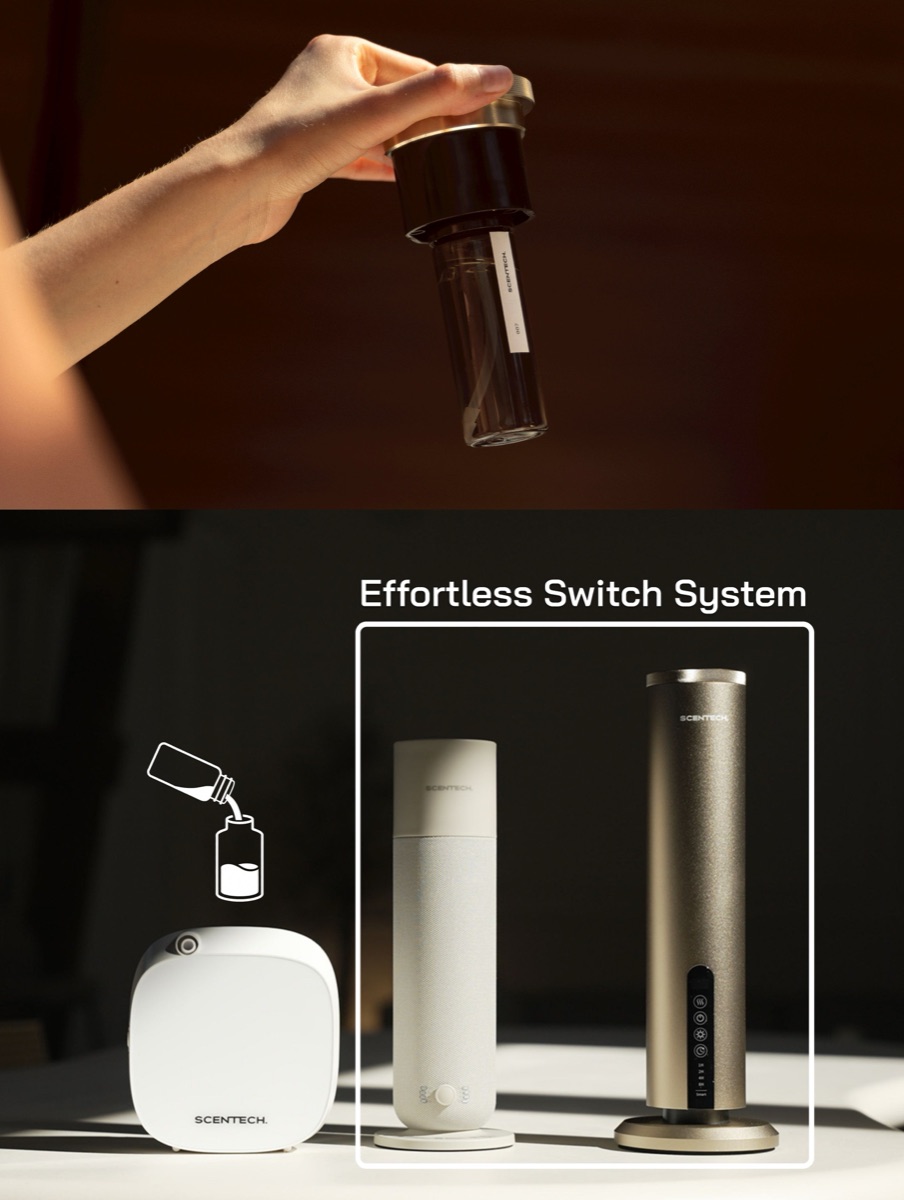
Scentech's offer page adds a diffuser free from five scents, the Diffuser 2 from seven and the Pro from nine; it is added automatically only through that page. They take sealed pods of blended fragrance oil and no essential oils. 30-day returns · 1-year warranty · ships from the Netherlands; UK availability and cost are shown at checkout
Advertisement See the offer at ScentechThe seven machines, their published figures and what each one is best at are on the front page, and the criteria behind the scores are on How we compare.